Tuesday, May 1, 2012

another swarm and not as easy as the last oner


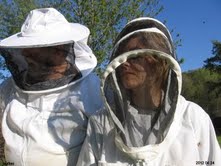
Another hive swarmed and choose an old satellite receiver. Hilary moved them into a new hive but after two hours they left the hive and returned to the satellite receiver. It is anchored on a hollow pole and the queen may be there, inaccessible. So, Hilary moved them again to a new hive, we will know tomorrow if  she got the queen or they decide to stay in the new hive.
 .................


https://blogger.googleusercontent.com/img/b/R29vZ2xl/AVvXsEj5dZ4b7ErnY0HeKz5wT3VbnRAoVJLGe_P7uhFwiVdKAB4kr8F8XiyNd72IfSjqnqDvdPdVUvFSTma_YlcJXujsi9lDRE4lRxo3oofIPozxiF7Fzs29mh1pGiGoR0AsMzBkf3l-cU6q7D8/s1600/2013-05-16+flowering+trees.jpg
https://blogger.googleusercontent.com/img/b/R29vZ2xl/AVvXsEibcbnoKaZJsvCG37bHdXKYh_XTRL0SBNm91__4reuLwHDYTq5qpgZjo2kIVwfojA1OQoUMOn74jNb6cfPk8RW9Xin3WuIBqXx-CJl1VlblwBvFnFpNjCYpdrtetN5eDQhS9wlL_NB1hlw/s1600/2013-05-16+toads.jpg

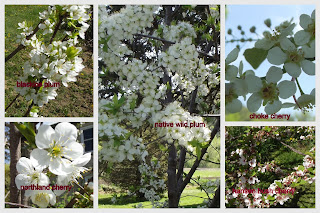
The flowering trees should provide ample food for the bees. They seem to prefer wild plum and choke cherry.  As usual, I can not locate their main food source but it does not seem to be any of these blooms.  The bees use the spring fed pond  for water and yesterday toads were also there in abundance.


Their charming  sound is almost deafening.  They have been active for three days and are very docile when approached slowly from the water.  Thirty years ago there were very few, if any, toads at this location.  Although I gardened a lot, I never saw one.  The area had been exposed  to a lot of chemicals for corn.  About fifteen years ago,  Hilary and I stopped on a highway to avoid hitting hundreds of toads. Many were crushed by cars.  We scooped up as many as we could, helping them cross the road, and took about twenty with us and released them here.  We have had toads in abundance ever since. 

Tuesday, April 24, 2012

swarm April 24 2012

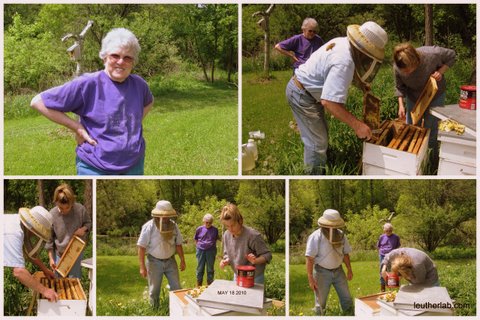
 April 24, the bees not only survived the mild winter, they flourished.  This is an early swarm we were lucky enough to catch.
Don sawed off the branch of the cherry tree until it was accessible by ladder.  Hilary gathered the
bees by hand, carefully scooping them into a garbage bag. Then she emptied then into the waiting hive.
We never did see the queen, but all the bees stayed with the hive so she must be in the hive. We will move the hive to a better location tomorrow!


.


Bees survived the winter

Monday, March 19, 2012

starting up for 2012 is not this easy in Wisconsin

All three hives survived the exceptionally mild winter. And, the swam last year ended up in a neighbors hive. At least we think it originated here, without DNA testing, who can be sure. The neighbors sold their house and when attempting to move old hives they thought empty, they heard bees. So, Hilary and I retrieved the bees, hive and all, (thank you neighbors) carefully putting the hive on a wagon and pulling it home. Word of caution, when attempting this be sure to use an adjustable strap to hold the supers together, especially when on a hillside. Despite one major tip over, the bees appear to be healthy and thriving. Oh, the picture is from Florida. What an easy life the bees and keepers must have in a warm climate.

Monday, October 17, 2011

In memory of Paul and Dorothy Hess


Paul and Dorothy Hess died after a car accident this month. Words are inadequate to express the sadness we feel. They were wonderful giving people, generous with their time and knowledge and had so much yet left to share with us all. October 17, 2011

Sunday, September 25, 2011


More tests were done on this honey than usual, in fact, most marketed raw honey has no laboratory testing at all. Notice that the high profile microbes are all less than 3/gram, or better. The mold count, probably comes from viable spores, since no fungal structures were microscopically observed in product. Most of the honey now has been extracted and put in jars of all sizes. Several pounds remaining will be sterilized and made into honey-butter, whipped honey and just sterile honey for Max.

Monday, September 19, 2011

collecting honey


After Hilary opened the hives and smoked the bees slightly, Paul used a leaf blower to brush off the bees remaining on the frames removed from teh hive. This was fairly gentle and a lot faster than by hand. The bees were later given sugar water, not a fair trade, but it pacified them somewhat.

Golden rod and wild asters are abundant but not many other flowers are available now. Lidino clover planted this spring did not do well, the area is probably too wet.

We have not weighed the extracted honey yet, we also saved several frames for comb honey, actually our favorite for eating.


Tomorrow Hilary and I will test composites for Salmonella, Listeria, total coliform, E. coli, staphylococci, streptococci and clostridium. We do this periotically when we remove honey, with satisfactory results.